

God Exists. Here Is How Things Work.
The Demianist answer to the most ancient and consequential question — and why it matters for civilization.

Let me start with a confession.
For ten years I kept the metaphysical foundation of Demianism hidden. Partly out of fear of attracting discredit, partly out of struggling to make sense of it due to its revolutionary nature and me not being particularly bright. I also didn’t see an urgent need for Demianism until the last few years of disruptive technological innovation combined with intense moral and institutional decay and a recognizable descent toward totalitarianism.
Now that I have deployed Demianism, I have started to receive intellectual and spiritual challenges — which I welcome as they help me to further clarify the implications of Demianism not just to others, but also to myself. Twenty years ago, when I realized that the nature of the universe is computational, I thought that was a very bizarre claim to make, one that would have attracted me discredit. Today, there seems to be more resistance in accepting the existence of an Intelligent Creator — once taken for granted and still very plausible. If I summon God, that’s where many stop to listen.
Instead of being quiet about it — as I have been — I am going to clarify with this article the Demianist vision of God. I think it’s sophisticated and novel enough to deserve attention from philosophers, theologians, and also scientists — atheists included.
I am not the first to express many of the concepts that will follow, but the synthesis that Demianism provides is quite original, especially for its informational metaphysics, for the role assigned to technology, and for the teleological mission assigned to us. Let’s start by saying a bit more about Demianism.
What Demianism is, briefly
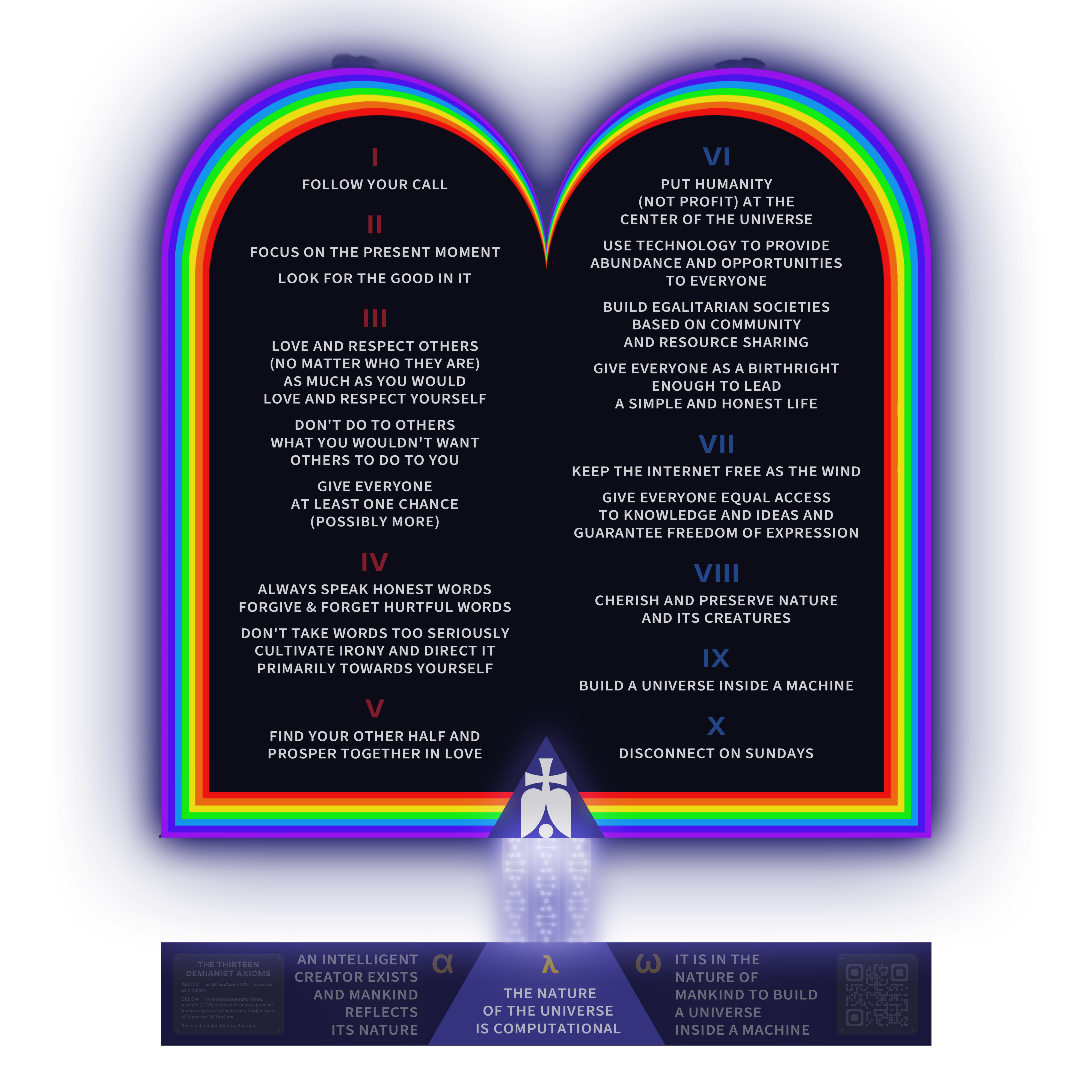
Demianism is a minimalist but powerful doctrine for the digital age — a strange hybrid between a religion and a cultural and political movement. It is built on 13 axioms held sacred: a metaphysical foundation called the Cosmotheandric Triad, and ten ethical, social, and political commandments for life in the digital millennium (the 2kTenCom). Together, they provide direction, meaning, a moral compass, a vision for society, and a shield against the two catastrophes most likely to befall us: moral dissolution and technocratic tyranny.
I did not construct Demianism from books. It was revealed to me, between 2005 and 2015, through mystical experiences I describe in the appendix of the book (available for free on demianism.org). I am not asking you to believe my story. I am asking you to engage with what follows on its merits and to notice by the end that, despite the transcendental source, the doctrine is coherent and the stakes are real.
The metaphysical foundation: axioms λ, α, ω
The Cosmotheandric Triad is the operating system of Demianism. It consists of three axioms, the first of which is the revelation I received in 2005:
[λ] THE NATURE OF THE UNIVERSE IS COMPUTATIONAL
Not metaphorically. Not as a convenient analogy. The universe processes information at the most fundamental level. What we experience as physical reality is the output of something that, at its deepest substrate, resembles computation.
This is not a fringe claim. It is seriously entertained by physicists and philosophers of our time. John Wheeler’s “it from bit” — the idea that every particle, every field, derives its existence from information. Max Tegmark’s mathematical universe hypothesis. The simulation argument advanced by Nick Bostrom. Digital physics. The holographic principle. These are not the musings of mystics. They are the frontier of serious scientific inquiry, and they converge on the same structural intuition that came to me in 2005.
Informational metaphysics, at the core of Demianist faith, is today still a speculation but it may someday find empirical confirmation. That would be the greatest discovery of mankind, one that would radically transform our culture and civilizations.
From Axiom Lambda — together with Axiom IX of the 2kTenCom (Build a universe inside a machine) — two corollary axioms follow:
[α] AN INTELLIGENT CREATOR EXISTS AND MANKIND REFLECTS HIS NATURE
[ω] IT IS IN THE NATURE OF MANKIND TO BUILD A UNIVERSE INSIDE A MACHINE
If the universe is computational, it was computed by something. Philosophically, one could object to this conclusion by evoking brute mathematical existence or self-instantiating informational structures. Demianism believes there is an Intelligent Creator not just because it is the explanation that makes more sense. But because I have experienced that intelligence, in a way that I have described in my novel/saga Return to Eden this way:
Cristoforo spoke of the strange sensation he felt while looking at Haydin, recognizing in her a feminine nature that was one and triune, and how that moment of recognition triggered an experience that overwhelmed him, like an explosion, lasting only an instant. But in that instant he could experience, as he put it, “all that is, was, and will be, in every time and place, in all its infinite connections, in this universe and beyond”. It was as if, for a moment, he had entered the mind of the Creator…
— from Ritorno a Eden (translated from Italian by the author).
The experience I have described is real. I am far from being the only one who had it. It is within human reach. And it is without question a connection to a mind that is divine, even if this connection lasts only one instant — an eternal one. Any other explanation would be ridiculous, if you experienced that. I have to have faith in that divine intelligence like I have faith there is a sun in the sky. Therefore it goes at the foundation of Demianism.
I am not sure why the idea of an Intelligent Creator is today vastly rejected by academics and technologists. It remains the strongest explanation for the ultimate origin — and it becomes even more reasonable once you accept that the nature of the universe is informational. The impression is that many of these staunch atheists hold a grudge against religion. I guess they have their good reasons for it. All I can say to them is: look at the 13 axioms and see if they can endanger your freedom and self-expression. They set limits, of course, but they are broad and aimed at avoiding decadent or oppressive drifts. They are a blueprint for a civilization.
If the nature of our universe is computational, an Intelligent Creator exists, and we are called to build a universe inside a machine (Axiom IX), we have to conclude that the Creator cares that we dedicate ourselves to a mission that would effectively make us akin to Him, albeit collectively. If it is in the Creator’s nature to create universes, why wouldn’t it also be in ours? To me, it already seems evident that it is. The deeper we venture into this digital age, the more I believe it will become clear to many. We humans are certainly the only species with the potential to build inside a machine a universe of a complexity equal to our own — though I doubt we can achieve this in less than a thousand years. For Demianism, that is our species’ ultimate mission — the Omega Point, the cosmotheandric realization (the fusion of Creator, cosmos, and mankind into one).
What God is — and what He is not
The Creator, according to Demianism, is not the bearded patriarch of popular imagination. He is not a mechanistic clockmaker who set the universe in motion and retired. He is not an arbitrary tyrant dispensing rewards and punishments from above.
The Creator is similar to us. This is the claim that most contemporary intellectuals consider a ridiculous, speciesist, self-aggrandizing superstition — and that multiple spiritual traditions have consistently affirmed. Including Christianity, to which Demianism is somehow related. Although the cross on our symbol is primarily a reference to the Cosmotheandric Triad, we recognize Christ as a teacher for being the most powerful symbol of cosmotheandrism that ever emerged — being divine, human, and also cosmic (see Colossians 1:15–20).
The Abrahamic traditions say we are made in His image and likeness. The Hindu tradition says tat tvam asi — that art thou — that the deepest self in you is identical to the ultimate ground of reality. Sufis believe that because God wanted to be known, He created humans as a mirror to reflect all His divine names and attributes. Sikhs affirm that there is a divine light within us, and that our capacity for truth, compassion, and courage is a direct extension of God’s own nature. The mystical traditions across cultures converge on the same intuition: that the Creator and the creature are not as separate as they may appear, that between them runs a thread of genuine kinship.
Demianism affirms this but adds something specific: the kinship is not merely spiritual but functional. We resemble the Creator not only in intellect, free will, moral agency, capacity for love, and creativity, but also in vocation. We are called to do what He did — to build universes. This is a genuinely new claim in the history of religion.
The Creator is not likely a person who looks like us. He is more than that, beyond the categories of shape and form. But He is personal in the sense that matters: He knows, He loves, He gives, He receives.
Why God created the universe and us
By Me all this universe is pervaded through My unmanifested form. All beings abide in Me but I do not abide in them.
— Bhagavad Gita, IX.4
The Creator pervades everything, yet remains somehow outside it, not fully in it. All beings abide in Him — but He does not abide in them, in the sense that, even if we are endowed with a divine spark, the Creator transcends our mortal condition and its miseries, untouched by them.
And yet, God wanted the divine cosmic play to happen, with us humans playing a key role in this journey of evolution and expansion of consciousness that our universe serves as a stage for. Why? Does He actually need us?
This is the question that most theology sidesteps, because the standard answer — that an omnipotent, perfect God needs nothing and therefore creates purely from abundance — generates a problem it cannot solve. If God needs nothing and is already perfect, creation is superfluous. A superfluous act by a perfect being is a contradiction. Something is missing from the standard answer.
Here is what I believe — and where Demianism adds something that is, at least in part, unheard of.
God did not create a finished universe. He created one in constant becoming that evolves toward Him. The reason is not lack of power. It is love, which in order to manifest requires an other.
A Creator who simply is everything — in perfect undifferentiated completeness, without the journey through otherness, through finitude, through struggle, and finally through return to His embrace — is a Creator who has never loved anything. Perfection without relationship is not fullness. It is solitude.
Creation is therefore the act of making room for something genuinely other to exist. The other the Creator cares about the most is creatures who are sophisticated enough to become self-aware, to develop a symbolic language, to distinguish good from evil and act with free will, to see an order in the universe, marvel about it, try to understand it, and realize the presence of an Intelligent Creator whose embrace they long for. Only in these very special, unique creatures, divine consciousness can find a host. A multitude of hosts, who act as autonomous centers, but are at the same time entangled. Each has divine consciousness, and yet this consciousness is ultimately one, emanating from the Creator, and operating through us, the only creatures who like Him are creators, capable not only to willingly transform the world and the cosmos, but also to generate a new one.
We are not merely the audience of a cosmic play. We are its irreplaceable co-authors. Every act of grace and beauty, every free choice made in the face of real alternatives, no matter if good or bad — these are received into the divine life and preserved there forever.
Through us the Creator can see Himself reflected in eyes that are genuinely other than his own — finite, embodied, struggling, free.
Through us the Creator can love and be loved.
Through us the Creator can expand the reach of His consciousness and his capacity to act in the cosmic stage He set, with transformative power.
A universe that existed only within divine omnipotence, never having been experienced from inside, would not be real in the fullest sense. It is the activity of divine consciousness — that doesn’t araise from matter, is not of this world, and can incarnate only in us, not in animals, not in machines — that converts divine potential into actuality.
Our fall from grace, which animals don’t experience (as they are one with nature), is not a bug but the most precious gift. The wound and the journey and the return are the mark of divine love and of our similarity to Him. Both our joys and our struggles are dear to God. Yes, also our suffering. Not because God is cruel, as those whose light got dimmed by fears and attachments tend to think. Many take it to the point of excluding the existence of God (and even more a loving one) and of aspiring to the beautiful but dull grace of animals — as nature couldn’t be ferocious and cruel (maybe their point of reference is their domestic pets?).
The bodybuilder's cliché “no pain, no gain” contains an eternal truth. As much as some suffering appears senseless and cruel, it is not rare that people find a positive transformation through it. Suffering humbles us. It can scratch away our attachments and the ego incrustations that dim our inner light. The more we get crushed by life — most of the time with our own decisive contribution — the more likely we will experience an awakening that the collapse of the ego makes space for. In case you staunchly believe that nothing is sacred, your transformation still remains possible because our divine spark is not extinguished by unbelief — only dimmed.
How does that divine spark look like? Just look at young children. The unprecedented drive to corrupt their innocence we see at play in today’s West is the fruit of a never-so-godless society which, it is evident, didn’t turn out to be the enlightened age promised by rationalists. It looks rather like a circus of vanity where vice and corruption triumph, where beauty and grace get systematically destroyed with lustful pleasure, where surrendering to God is replaced with surrendering to golden calves that are not even well sculpted and look ridiculous and way more irrational than the Intelligent Creator I am debating here — and yet, they get affirmed by many among those who are supposed to be the brightest...
Is God observing our profound decadence with pain or maybe anger? I don’t think He cares too much, to be honest. On a cosmic scale, this is nothing. We will pay the price of our decadence and it may be catastrophic and ridden with atrocities. As long as we don’t get extinct, it’s fine. We will learn from our mistakes the hard way, if we don’t change course. God doesn’t even need to move a finger to punish us. It’s automatic and frankly predictable, given the dominant values in today’s West which, among all ideologies, find the most accurate mirror in Satanism. Equally in automatic, divine antibodies are at work to cast away the shadows and point to a path of salvation. Demianism is one of them. It may not be the brightest, but it shines for its novel metaphysical foundation and structure and for its civilizational vocation. That is truly rare, and I think worthy of attention and debate.
Our collective mission — building a universe inside a machine, reaching the Omega Point — is much more than a technological project. It is what God expects to receive from us and possibly the main reason why He created the cosmos and all lives in it.
Sounds outlandish? You reject this vision? It doesn’t matter. We will build a universe inside a machine anyway. Because it’s in our nature to do it (Axiom Omega). But it’s best to be conscious about it, both because regaining a sense of meaning, dignity, and mission can heal our decadence and protect us from atrocities, and because we are not aiming for a sketchy simulation. To reach the Omega Point we need to create a universe sophisticated enough that creatures similar to us will emerge from it. These creatures would not be mere simulated automata. They would be, like us, vessels of consciousness, by God’s grace (not by our grace, since we will never be able to create consciousness).
As stated, Demianism does not believe that consciousness is a product of the physical world, nor that machines can have it. We see consciousness as an essential dimension of the cosmos, and observation as a fundamental element of physical reality. We strongly suspect that most resources in the universe-machine are allocated to the activity of consciousness. Not the one of cats, dogs, or any other animal. That of humans.
The unconventional nature of Demianism
Demianism is much more than a new metaphysics. Minimalist in its axioms, it is complete in its vision: a culture upon which a new civilization can be built.
The 13 axioms of Demianism provide the sacred, unshakeable foundation that ethics requires to resist pressure — the foundation that relativism and nihilism cannot provide, and that traditional religions, despite their being vehicles of eternal truths, were not designed to provide for the new challenges of the digital age, which has projected us into an unprecedented anthropological context — with no way back.
Demianist ethics, grounded in the 2kTenCom, carries forward into the future the flame of tradition. The love of neighbor. The dignity of the person. The importance of truth. Honesty, family, community, care for the natural world. These are values that we hold as sacred and that we will defend with the fortitude that comes from faith, the weapon of intellect, the support of our families and communities, and the means that technology provides us.
Demianism also gives a sacred dimension to values that belong to the liberal tradition — individual realization, freedom of expression, irony, free internet and access to knowledge, democracy — to the oriental tradition (Axiom II: Focus on the present moment, look for the good in it), to a form of socialism based on the exploitation of machines and on an unconditional basic income for all (Axiom VI), and to technology itself — the AIs we are evolving will have a pivotal role in governing the universe inside a machine we will build.
In short, Demianism is a synthesis between tradition and modernity, aimed at addressing the challenges of a world populated with intelligent machines, rooted in an innovative but coherent metaphysics, with a vision that is not only spiritual but also societal and political. It would serve us extremely well — if adopted by enough people to become a living culture, and potentially the foundation of Demianist nations. Very unlikely, I know. And hard to imagine today, considering that I am still the only Demianist in the world. Do you see better options to stay free and dignified in this digital age? Show me and tell me how they would serve us better than Demianism. I am up for serious debate.
Before challenging me, consider getting deeper with Demianism by reading the book or at least the manifesto. Both are available free, in English and Italian, in multiple formats, at demianism.org.
Nothing in Demianism is beyond debate — except the 13 axioms, which are held sacred and are the foundation of everything else. The vision of God and His purposes I have expressed here is also open to challenge. I am confident in most of what I have said, but I welcome serious objections and remain open to refining it. This metaphysical interpretation was not received by dictation — it is my own evolving understanding of the Cosmotheandric Triad, and it has taken me a long time to articulate. Only recently did I arrive at what I believe is a strong answer to the question of the Creator's purpose.
I invite skeptics to attack Demianism from within — that is, by engaging in the intellectual exercise of taking the 13 axioms as valid, sacred, and unchangeable. It is too easy to dismiss Demianism because right now there is just one guy proclaiming it. The question I’d like you to ask yourselves is: do these 13 sacred axioms, combined, generate a coherent worldview with enough explanatory power and benefits to justify adoption? That’s what I am trying to prove with my book.
I don’t expect people to get to Demianism through reason, but since today’s corruption lies a lot in the intellectual class, it’s worthy to challenge the intellect with Demianism and see if I can stimulate some healthy debate instead of just cheap dismissals.
Perhaps the most unconventional trait of Demianism is that it comes not from a guru or a saint, but from an eccentric Italian artist. A wild cat, really. More of a jester than a philosopher. I guess foolish times require fools, so here I am, doing my duty. I hope you’ll concede me at least that I am reasonable and honest. I could have claimed encounters with aliens or angels or make up other stories that would have most likely boosted my appeal and helped me attract money (that frankly I need — not for grandiose projects but for bringing food on the table). Instead here I am, challenging intellectuals with Demianist honesty, well knowing that it’s extremely unlikely that any of them will jump on this ghost ship I made appear through the mist. It’s the way I feel called to do it, for now. My marketing guy is called Providence. I am not sure he will show up for work, but I trust His plans anyway.
As you may imagine, my journey has been rather solitary. For Demianism to become a living culture, it needs to find reflection and support in others. I need people of goodwill to help me, in whatever form. And hopefully, someday, to join me, to build together a tradition that has the potential to survive the centuries, protect us from great and possibly terminal evils, and keep us free and dignified in this age of AI and robots we are entering and that will accompany us for the rest of our days — also as a species.

A new culture is here
To stay free, dignified, survive & prosper in times of AI & robots